

Plan ahead
Avoid ejaculation and vigorous exercise, including cycling, for 48 hours before PSA testing. Ask your GP about timing after prostate stimulation.


VivaTest PSA Prostate Test Kit is a convenient home self-test designed to detect prostate-specific antigen, commonly known as PSA, in a finger-prick blood sample.
This compact rapid test kit is designed for men who want a simple and private way to carry out a PSA check. The test uses a small blood sample and a clear cassette-style result window, making it straightforward to use with the included instructions.
PSA is a protein produced by the prostate. PSA levels can vary for several reasons, including age, prostate enlargement, inflammation, infection, recent ejaculation, or other prostate-related changes. A PSA test can be a useful first step in checking prostate health, but it should not be used as a diagnosis on its own.
To understand what PSA testing can show, how results are interpreted and when to seek further advice, read our PSA test guide: prostate health, levels and results.
Why choose the VivaTest PSA Prostate Test Kit?
What is included?
Who is this test suitable for?
This PSA rapid test kit may be considered by men with concerns about their prostate health. Discuss whether PSA testing is appropriate for you with a GP or qualified healthcare professional, particularly if you have symptoms or ongoing concerns. Always follow the intended use and instructions supplied with your kit.
Before using your PSA test kit
For information about test timing, exercise, recent infections, medicines and other factors to discuss with your healthcare professional, read our PSA test preparation guide: what can affect your result?.
Follow the sample collection procedure and exact result-reading time in the leaflet supplied with your kit.
Important information
This test is a testing aid only and does not diagnose prostate cancer or any other medical condition. PSA levels can be raised for several reasons, and a positive or abnormal result should always be discussed with a GP or qualified healthcare professional.
A negative result does not rule out prostate cancer. If you have urinary symptoms, pain, blood in urine or semen, unexplained weight loss, or ongoing concerns about your prostate health, seek medical advice. Do not delay seeking help because of a test result.
PSA testing and prostate health resources
Explore our PSA Test Resources for educational guides covering prostate health, PSA testing, preparation and understanding results.
These resources support informed conversations with a healthcare professional and do not replace the instructions supplied with your kit or medical advice.
Clear pricing, free UK delivery and UK-based customer support.
Your PSA kit at a glance
A finger-prick test for total prostate-specific antigen (PSA), with a result you read at home.
One test kit · one personMake an informed choice. A PSA self-test cannot diagnose or rule out prostate cancer. Discuss the benefits and limitations of PSA testing with a GP before deciding whether to test.
Understanding PSA
PSA is a protein produced by the prostate. Some PSA in the blood is normal. Levels can change with age, prostate enlargement, inflammation, infection and cancer.
This is a qualitative test: it gives an indication relative to its cut-off. It does not give an exact PSA number or show how a PSA level changes over time.
A laboratory blood test can report a numerical PSA value. Your GP considers that value alongside your age, symptoms, medical history and other findings.
Read the VivaTest PSA guide →How this kit reports a result
The manufacturer's detection cut-off for this cassette.
A device cut-off is not a personalised normal range. Clinical assessment may be needed at lower PSA levels, depending on your circumstances.
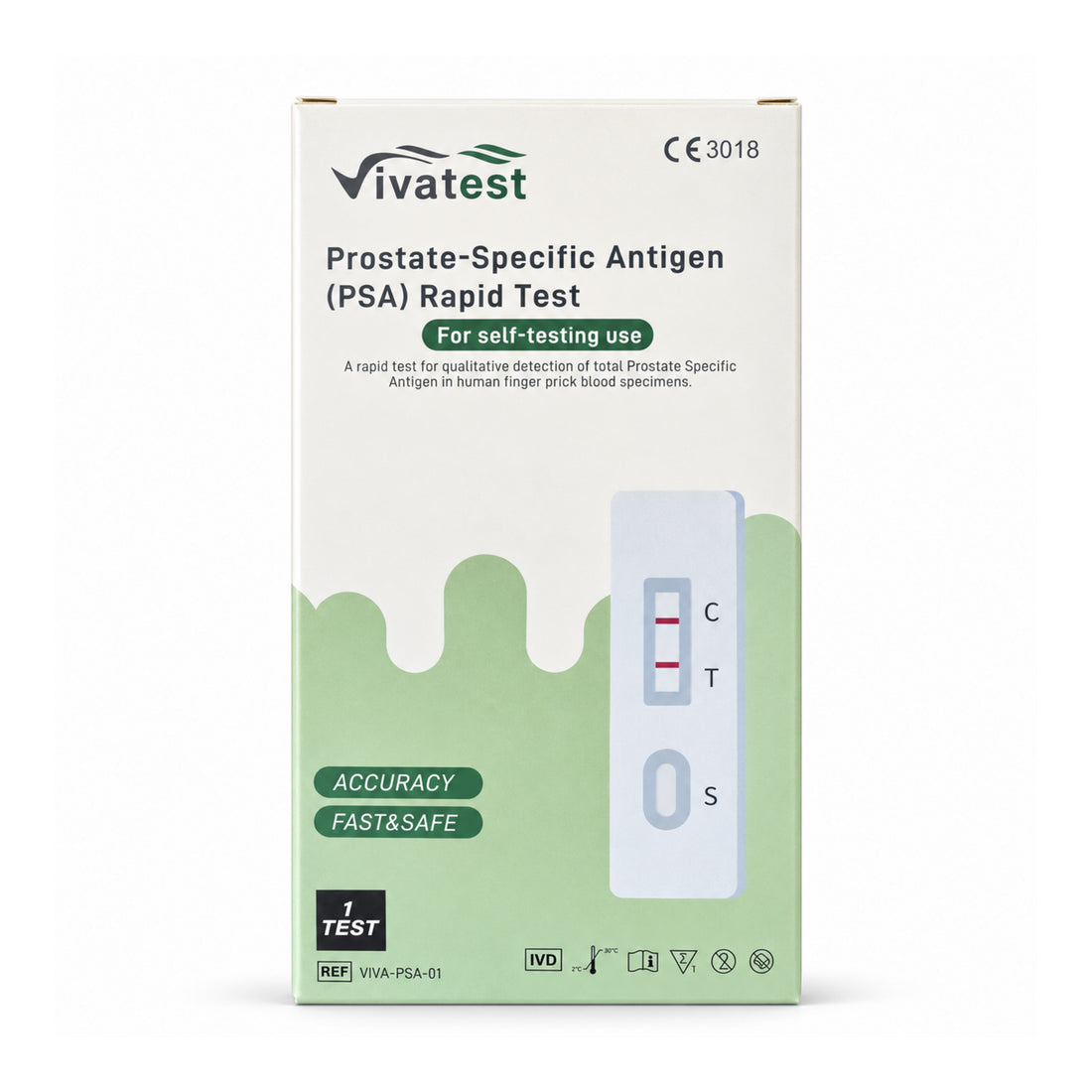
Inside your kit
Have a timer ready; one is not included. Follow the leaflet supplied with your pack.
Read the PSA leaflet (PDF) ↗Before you test
Activities, recent medical care and medicines can affect PSA. Plan your test with that context in mind.
Avoid ejaculation and vigorous exercise, including cycling, for 48 hours before PSA testing. Ask your GP about timing after prostate stimulation.
A urine infection, prostate biopsy, urinary catheter or procedure can affect PSA. Ask your GP how long to wait before testing.
Finasteride and dutasteride can lower PSA. Tell your GP about medicines and prostate treatments. Keep taking prescribed medicine unless your clinician advises otherwise.
PSA testing is a personal decision. Age, family history and Black ethnicity can affect prostate cancer risk. A GP can help you decide which test and follow-up are appropriate.
Read the PSA preparation guide →Using your PSA kit
Check the leaflet, expiry date and pack condition.
Use the lancet and capillary dropper as directed.
Apply blood and buffer according to the leaflet.
Time from adding buffer. Do not interpret after 10 minutes.
This overview supports the full instructions supplied with your kit.
Reading your result
C is the control line; T is the test line. Use the leaflet's result pictures and the specified reading time.
Arrange a GP appointment. Your GP may repeat PSA with a laboratory blood test and assess possible causes. A raised PSA result does not by itself mean cancer.
A negative result cannot exclude prostate cancer or another prostate condition. Speak to a GP if you have symptoms, increased risk or ongoing concerns.
Repeat with a new test, following the leaflet.
Seek medical advice for changes in urination, blood in urine or semen, or persistent concerns. Act on symptoms even after a negative home test.
Certification & manufacturer evidence
The AllTest TPS-NQ402H PSA model family is listed as Class C for self-testing on the manufacturer's EU Technical Documentation Assessment Certificate issued by Sertio Oy, notified body 3018.
Certificate: EU-TDA-FI-51326-800081-2026, version 3.
Manufacturer: Hangzhou Alltest Biotech Co., Ltd.
Regulation: (EU) 2017/746, Annex IX, Chapter II.
Manufacturer-reported study
| Measure | Agreement |
|---|---|
| Positive agreement | 99.0% |
| Negative agreement | 99.4% |
| Overall agreement | 99.2% |
AllTest reports 266 clinical specimens compared with CLIA, a laboratory PSA method. Source: TPS-NQ402H leaflet, document 14603097401.
Interpret these figures in context. Agreement on PSA results is different from accuracy for detecting prostate cancer.
View the manufacturer's study data (PDF) ↗Clinical guidance sources
This test is designed to detect prostate-specific antigen, also known as PSA, in a finger-prick blood sample. PSA is a protein produced by the prostate, and PSA levels can vary for several reasons.
Yes, this is a home PSA self test kit designed for private at-home use. Always read the instructions carefully before using the test.
No. This PSA test does not diagnose prostate cancer or any other medical condition. It is a self-testing aid only. If you receive an abnormal result or have symptoms, speak to a GP or qualified healthcare professional.
The test uses a small finger-prick blood sample. The sample is applied to the PSA test cassette following the instructions supplied with the kit.
The test is designed to provide a rapid result. Follow the exact reading time shown in the instructions supplied with your kit.
The kit includes the PSA rapid test cassette, sealed test pouch, sample collection components and instructions for use.
PSA levels may be affected by several factors, including age, prostate enlargement, inflammation, infection, recent ejaculation, exercise, or other prostate-related changes. A raised PSA result should always be discussed with a healthcare professional.
If you receive a positive or abnormal result, do not panic. Contact your GP or a qualified healthcare professional for further advice and follow-up testing if needed.
If you have symptoms such as difficulty urinating, frequent urination, pain, blood in urine or semen, or ongoing concerns about your prostate health, you should speak to a healthcare professional. This test can be used as a self-testing aid, but it should not replace medical advice.
This PSA self test kit may be useful for men who want to monitor their prostate health from home. However, PSA testing should be considered alongside your age, symptoms, medical history and advice from a healthcare professional.